

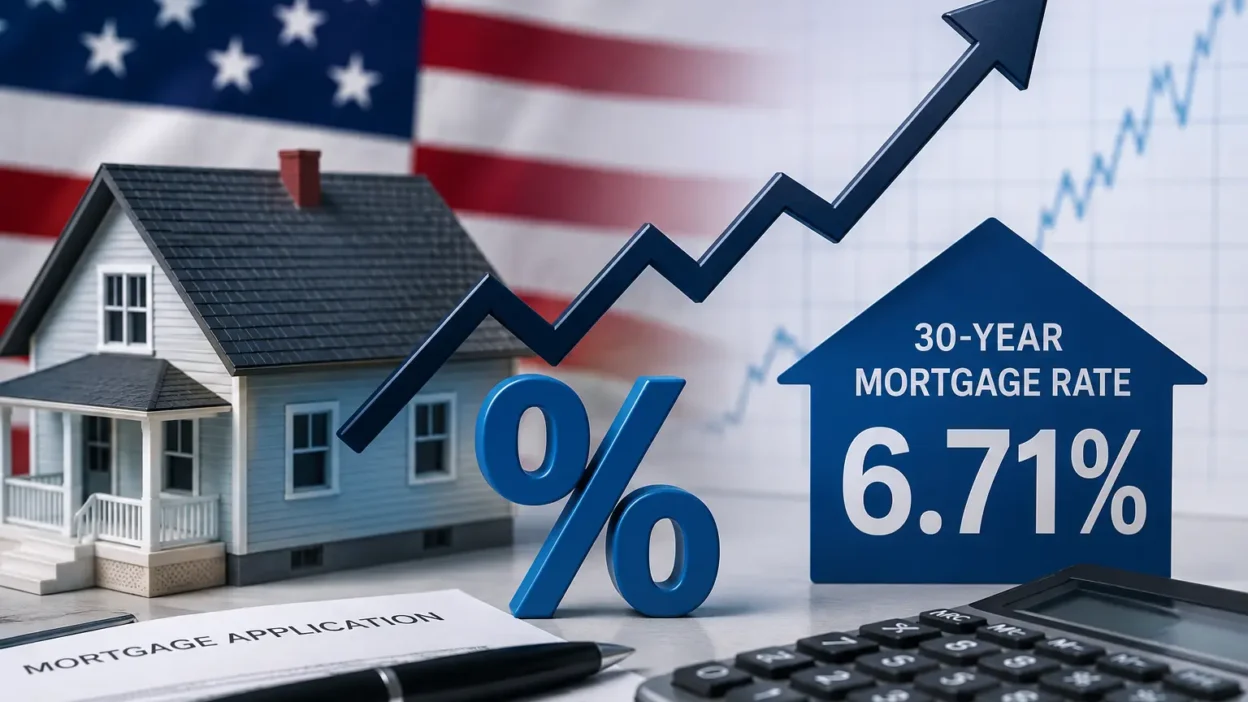
Mortgage rates rose again this week, pushing the average U.S. long-term home loan rate to its highest level in more than a year and dealing another setback to prospective buyers already navigating one of the most affordability-constrained housing markets in recent memory. The average rate on a 30-year fixed mortgage climbed to 6.71%, up from 6.66% the previous week, according to Freddie Mac’s latest Primary Mortgage Market Survey released Thursday. It is the highest reading since July 31, 2025, when the average stood at 6.72%.
The increase, while modest on its face, extends a steady upward drift that has left borrowers paying noticeably more than they were a year ago, when the 30-year average sat at 6.5%. For a housing market that has spent much of the past two years waiting for meaningful rate relief, the latest data offers a reminder that the path back to more affordable borrowing costs remains anything but linear.
What’s Driving the Increase
Mortgage rates don’t move in a vacuum. They generally track the yield on the 10-year Treasury note, which lenders use as a benchmark for pricing home loans, and that yield is itself shaped by a mix of inflation data, Federal Reserve policy signals, and broader geopolitical developments. This week’s jump reflects several of those forces converging at once.
Chief among them has been renewed volatility stemming from the conflict between the United States and Iran. Jiayi Xu, senior economist at Realtor.com, explained that the Middle East conflict has put upward pressure on oil prices, which in turn has fueled inflation and pushed it further from the Federal Reserve’s 2% target. When the conflict appeared to be nearing a resolution in recent weeks, bond yields declined and mortgage rates eased in tandem. But the latest escalation in regional tensions has reversed that trend, driving oil prices — and with them, yields and mortgage rates — back upward.
Compounding the pressure is uncertainty around the Federal Reserve’s next move. Fed Chair Kevin Warsh said at the central bank’s annual economic symposium in Jackson Hole, Wyoming, that inflation had not shown sufficient improvement and suggested the Fed “might have more work to do” — language widely interpreted as a signal that he is weighing an interest rate increase at the Fed’s next meeting, scheduled for September 15–16. Wall Street now largely expects the central bank to raise rates before year’s end in an effort to cool inflation, which remains well above the Fed’s 3% comfort threshold, let alone its 2% target.
It’s worth noting that the Fed does not directly set mortgage rates. Its short-term rate decisions influence borrowing costs indirectly, largely through their effect on bond market expectations and Treasury yields. But because those signals are watched so closely by investors, even the anticipation of a Fed move can ripple through mortgage pricing well before any formal rate change is announced.
The Numbers Behind the Headline
Beyond the closely watched 30-year figure, Freddie Mac’s survey showed similar upward movement across other loan products. The average rate on a 15-year fixed mortgage, a common choice among homeowners refinancing an existing loan, rose to 6.04% this week, up from 5.98% the week prior. That represents a substantially steeper climb from a year ago, when the 15-year average stood at just 5.60% — a difference that adds up meaningfully over the life of a refinance.
Freddie Mac’s chief economist, Sam Khater, characterized purchase demand as holding relatively steady despite the higher rates, noting that buyers appear to be adapting to shifting market conditions rather than retreating from the market altogether. Still, the broader trend line is difficult to ignore: rates have now risen for multiple consecutive weeks, continuing a pattern that has repeatedly frustrated hopes of a sustained decline.
Why It Matters for Buyers and the Broader Housing Market
The practical impact of even modest rate increases can be substantial. Higher mortgage rates add hundreds of dollars a month in costs for borrowers financing a typical home purchase, directly eroding purchasing power and pricing some buyers out of homes they could have afforded just months earlier. That dynamic has been a significant factor behind sluggish home sales this year, as prospective buyers weigh whether to proceed at current rates or delay in hopes of more favorable conditions down the road — a bet that, so far in 2026, has not consistently paid off.
For sellers, elevated rates carry their own complications. Many homeowners who locked in considerably lower rates in prior years have little financial incentive to sell and take on a new mortgage at today’s higher cost, a phenomenon that has kept inventory constrained in many markets even as demand has cooled. The result is a housing market caught in something of a standoff: affordability pressures dampening buyer activity, while rate-locked homeowners hold back on listing, leaving transaction volumes below where they might otherwise sit.
Little Relief in Sight, Economists Warn
Perhaps most sobering for buyers hoping for a reprieve is the near-term outlook offered by market watchers. Xu was blunt in her assessment, saying there is little expectation of meaningful mortgage rate relief this fall, and cautioning that the situation could grow more difficult if inflation isn’t brought under control. That assessment aligns with the broader market expectation that the Fed may raise rates rather than cut them in the coming months, a scenario that would likely keep upward pressure on borrowing costs rather than ease it.
For now, both buyers and the housing industry are left watching the same set of variables that have driven this week’s increase: the trajectory of the Israel-Iran conflict and its effect on oil prices, incoming inflation data, and the Federal Reserve’s decision at its mid-September meeting. Any of those factors could shift quickly, but as it stands, the 30-year mortgage rate’s climb to a one-year high underscores just how tightly intertwined the housing market has become with forces far beyond it — from geopolitical flashpoints thousands of miles away to the incremental calculations of central bankers weighing their next move.
Whether this week’s reading proves to be a temporary peak or the start of a longer climb will likely depend on how those forces evolve in the weeks ahead. For now, buyers hoping to lock in a lower rate may find themselves waiting longer than they’d like.